
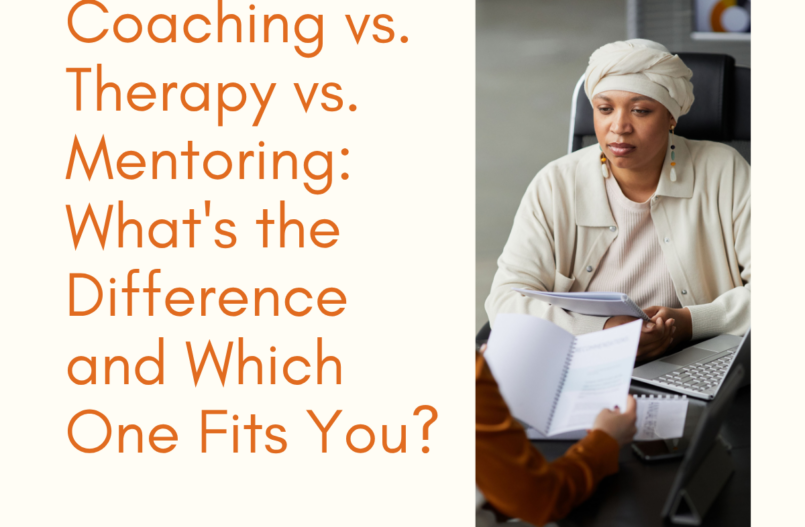
Not sure what coaching actually is? You’re not alone. Many people use the terms coaching, therapy, mentoring, and counselling interchangeably, even though they serve very different purposes. Big part of our work is to educate about the distinctions, so let’s dive right in. Understanding those differences is important whether you’re looking for support yourself or considering a career in coaching. Choosing the right approach starts with understanding what each one is designed to do.
Although the topics that emerge in these modalities sometimes overlap, each has its own core intention:
- Coaching helps individuals think more clearly, make intentional decisions, achieve meaningful goals, and develop their own capacity to navigate future challenges. The goal is not to provide answers but to facilitate better thinking and greater ownership.
- Therapy focuses on healing psychological distress, treating mental health conditions, or helping people process trauma and unresolved emotional experiences. Its primary intention is improved psychological wellbeing.
- Counseling helps people cope with personal, emotional, or situational difficulties such as grief, relationship challenges, stress, or life transitions. The emphasis is often on understanding feelings, improving coping strategies, and restoring emotional balance.
- Mentoring is built around the transfer of experience. A mentor shares knowledge, advice, and practical guidance to help someone develop within a particular profession, role, or field.
All four approaches can be deeply valuable. The question is not which one is “better,” but which one best fits the person’s current needs.
How is coaching different from therapy?
Therapy often helps people understand, process, or heal emotional distress, trauma, or mental health challenges. It may explore past experiences to improve wellbeing in the present.
Coaching, on the other hand, works with people who are generally psychologically well and want to move forward. A coaching conversation focuses on goals, decisions, leadership, career development, relationships, or personal growth. Rather than analysing the past, coaching helps clients develop new thinking and take meaningful action.
Professional coaches are also trained to recognise when coaching is no longer the appropriate form of support and another professional may be better placed to help. For example, if a client begins presenting symptoms of significant trauma, severe anxiety, depression, addiction, or other mental health concerns that require clinical expertise, an ethical coach will not attempt to “coach through” those issues. Instead, they will openly discuss the situation with the client and, where appropriate, recommend working with a qualified therapist, counsellor, or another appropriate professional.
Recognizing the limits of coaching is not a weakness. It is an essential part of professional coaching practice and one of the reasons ethics forms such an important part of ICF-accredited coach education.
What’s the difference between coaching and mentoring?
Mentoring is built on experience. A mentor shares knowledge, advice, and practical guidance based on their own professional journey. If you’re entering a new industry or role, having someone who has “been there before” can be incredibly valuable.
Coaching works differently. Instead of offering solutions, coaches help clients find their own. They ask thoughtful questions, challenge assumptions, and create space for deeper thinking. The goal isn’t to transfer expertise but to help clients develop greater clarity, confidence, and ownership of their decisions.
Where does counseling fit?
Counseling generally focuses on helping people understand and cope with emotional or personal difficulties. Depending on the context, it may involve exploring feelings, relationships, or specific life challenges in greater depth. Like therapy, counseling has different goals, training requirements, and professional boundaries from coaching.
While counseling often helps people understand and work through emotional experiences, coaching begins from a different place. It assumes that the client already has the capacity to move forward and focuses on expanding awareness, generating new thinking, and supporting meaningful action. Counseling often asks, “How can I better understand what has happened?” Coaching more often asks, “Given where I am today, what do I want to create next?”
Understanding these distinctions is an important part of professional coach education because knowing when not to coach is just as important as knowing how to coach.
What do we teach in our programs at UpThink Coaching?
At UpThink Coaching, participants learn coaching as its own professional discipline. Coaching is not a simplified version of therapy or mentoring. Our programs are accredited by the International Coaching Federation (ICF), the world’s leading professional coaching organization. This means participants learn and practice coaching in alignment with the ICF Core Competencies, develop a strong understanding of the ICF Code of Ethics, and receive education that meets internationally recognized standards for professional coach development.
However, meeting professional standards is only the starting point. We believe excellent coaching requires more than demonstrating competencies during an assessment. It requires developing the judgement, presence, and relational capacity that allow those competencies to come alive in real coaching conversations.
Our “Practical Coaching Mastery“ program is grounded in relational coaching, where the quality of the relationship becomes an important part of the coaching process. Participants develop emotional intelligence, cultural intelligence, reflective practice, and the ability to use self as tool, helping them work with clients from different backgrounds and in different professional contexts.
How do you learn that kind of coaching?
Learning to coach isn’t about memorizing questions or following a script. It develops through practice, reflection, and constructive feedback. For that reason, our programs are designed around experiential learning rather than lecture-based teaching. New concepts are introduced, demonstrated by faculty, practiсed by students immediately in coaching conversations, and then explored through structured feedback, mentor coaching, coaching supervision, and reflective discussion. Participants repeat this learning cycle throughout the program, allowing coaching skills and professional judgement to develop together rather than separately.
Many UpThink Coaching graduates consistently highlight the extensive coaching practice as one of the most valuable parts of the program, along with supervision, mentoring, and learning alongside an international cohort.
“Every time we practise, I go deeper, discovering more about myself and understanding more about what coaching can do.”
Is coach training right for you?
If you’re drawn to helping people think rather than telling them what to do, coaching may be a profession worth exploring. Coaching also tends to suit people who are naturally curious about how others think, comfortable continuing to learn throughout their careers, and willing to examine their own assumptions as carefully as they explore those of their clients. Many successful coaches come from leadership, HR, education, healthcare, consulting, entrepreneurship, and other professions where meaningful conversations are already part of their work. Rather than replacing their previous experience, coaching often expands the impact they can have through it.
At UpThink Coaching “Practical Coaching Mastery” Level 1 program provides the education required for the ACC credential, while “Beyond the Tools” Level 2 provides the education required for the PCC credential, together with the additional ICF credentialing requirements.
If you’re curious about coaching as a profession, spend some time exploring the programs and participant testimonials. Understanding how UpThink Coaching approaches relational coaching will give you a much clearer picture of whether this way of working resonates with you. If you’d like to have your questions answered, get in touch.