
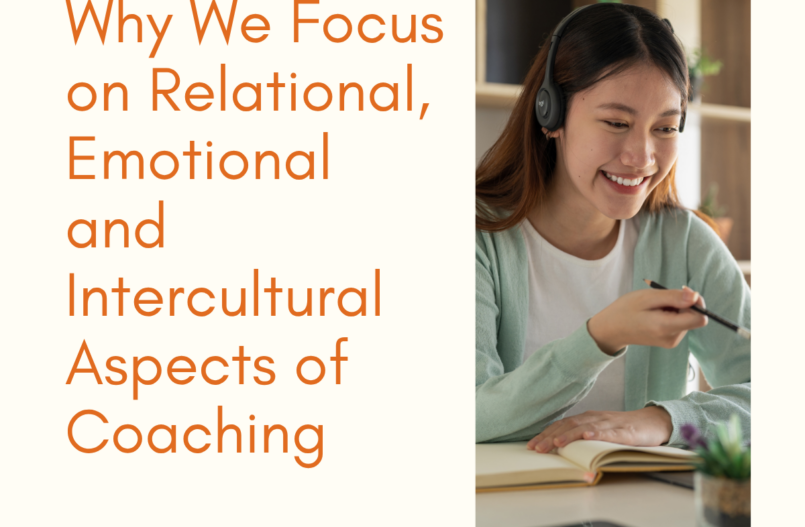
Every ICF-accredited coach training program teaches the ICF Core Competencies, ethics, and the fundamentals of professional coaching. That raises a reasonable question: what is the difference between all the different programs.
One of the core differences may be a distinct coaching philosophy or approach to this work.
For example, at UpThink Coaching our emphasis is on relational coaching, emotional intelligence, and intercultural intelligence.
Coaching does not happen in a vacuum. Every coaching conversation happens between people, which means that it is shaped by the relationship between coach and client, by emotions that influence thinking and decision-making, and by the cultural context both people bring into the conversation. We believe coaches become more effective when they understand these dynamics instead of relying only on coaching models and techniques. Our approach aligns with the ICF Core Competencies and helps coaches apply them with greater flexibility, discernment, and confidence.
Why isn’t learning coaching techniques enough?
Coaching techniques are valuable for beginner coaches, but the do not contribute much to the effectiveness of coaching. A framework can help a coach structure a conversation, yet it cannot tell them how to respond when a client becomes emotional, questions their own identity, or shows some biases or deals with communication challenges that may arise when they work across cultures.
Two coaches may use exactly the same coaching model and ask the same question. One conversation creates genuine insight, while the other may create an impression or a superficial conversation. The difference often lies in how the coach understands the person sitting in front of them rather than in the technique they use.
We do not rely on coaching techniques in coach training. Instead, we educate our coaches-in-training about coaching psychology and create a focus on deeper understanding of human relationships, emotions, and behavior. We primarily want coaches to understand why something works and how to use the coaching partnership as a resource in their sessions. Then the answers to the question “what should I do?” arises naturally.
Why does the coaching relationship matter?
Research shows that the working alliance (relationship between the client and helping practitioner) contributes to 40% of effectiveness in their work. Partnership is the key definition of coaching. Relational coaching is based on the idea that the relationship itself is part of the coaching process. Clients think more openly when they feel psychologically safe, understood, and respected. They are more willing to challenge assumptions, explore uncertainty, and discuss difficult topics when they trust the partnership they have with their coach.
That does not mean we often have to explore the coaching relationship in every session. We might, when it’s relevant but those decisions are situational. The coach pays attention to how the relationship supports or limits the client’s thinking. A hesitation, a change in energy, or an unspoken assumption can become valuable information that helps the conversation move forward. Developing this awareness allows coaches to maintain deeper presence that is focused on the other person, facilitate greater trust and safety and work with greater depth instead of simply following a coaching model from beginning to end.
The role of emotional intelligence in coaching
People rarely make important decisions based on logic alone. Even if they are structured and logical thinkers, confidence, fear, uncertainty, frustration, or hope all influence how people think and act.
Effective coaches use emotions as signals of the client’s meaning making process. They recognize when emotions are shaping the client’s thinking and create space for the client to explore them. Sometimes a client’s biggest obstacle is not a lack of options but an emotional response they have not yet examined. Understanding emotional intelligence helps coaches stay present without trying to fix, reassure, or direct the client. It also helps them notice their own emotional reactions and avoid allowing those reactions to influence the coaching conversation.
If you’d like to explore this topic further, listen to Episode 16 of the Coaching with Confidence and Care Podcast, where we discuss how coaches can work with emotions without taking clients’ emotions on as their own. (link to Episode 16)
Intercultural intelligence is becoming increasingly important
Professional coaching has become global. Coaches regularly work with clients from different countries, industries, organizations, and cultural backgrounds. Even within the same organization, people may have very different beliefs about leadership, communication, feedback, authority, and decision-making.
Without intercultural awareness, coaches can unintentionally interpret a client’s behavior through their own cultural assumptions. Questions or strategies (e.g. trust-building or direct communication) that feel natural in one culture may feel uncomfortable or even inappropriate in another. Intercultural intelligence helps coaches replace assumptions with curiosity. Instead of expecting every client to communicate or think in familiar ways, they learn to explore each client’s unique perspective before drawing conclusions. This makes coaching more responsive, respectful, and effective across different contexts.
For a deeper discussion of this topic, explore Episode 5 of the Coaching with Confidence and Care Podcast on intercultural humility for coaches, where we discuss why cultural curiosity is often more valuable than assuming cultural competence. (link to Episode 5)
How we integrate all these aspects into our programs
We do not teach relational coaching, emotional intelligence, and intercultural intelligence as separate subjects because they constantly influence one another during real coaching conversations. We are practitioners, and we train coaches to be confident practitioners as well.
A client may arrive with a leadership challenge that is also shaped by emotion, organizational culture, and the quality of the coaching relationship. Coaches who understand only one of these dimensions may miss important opportunities for deeper exploration.
Our philosophy of work is evident in both Practical Coaching Mastery (Level 1) and Beyond the Tools (Level 2) programs. Participants practice applying them during coaching conversations, mentor coaching, supervision, and reflective discussions instead of learning them only as theory. These perspectives help coaches move beyond following coaching models and toward building stronger partnerships, responding thoughtfully to complexity, and supporting clients in ways that reflect who they are rather than who the coach expects them to be.
Developing as a coach involves more than learning new techniques. It involves developing the judgment to recognize what each client needs in a particular moment and adapting your coaching accordingly. Although some coaching schools see these topics as advanced topics to explore after learning the basics, this is how we educate beginner coaches as well. To us, they are part of the foundation that helps coaches apply each and every coaching competency with greater depth, confidence, and professional discernment.
Contact us to explore your coach training journey.